


guptavikash7994@gmail.com
- February 26, 2026
- Digital Marketing
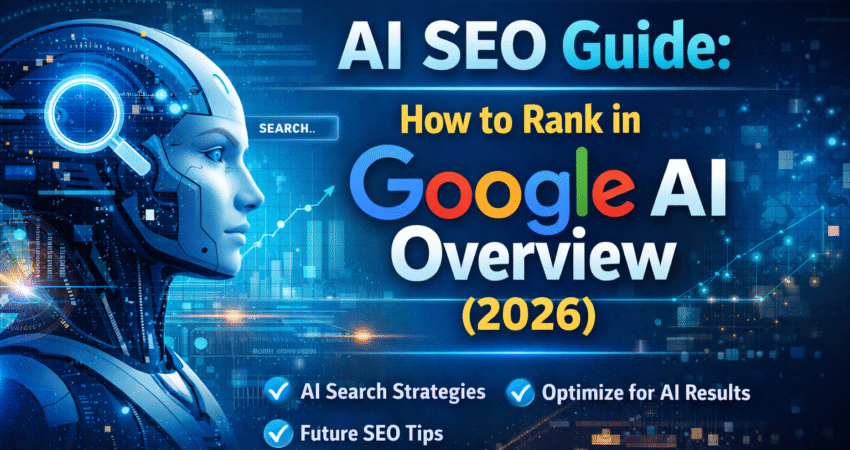
Search engines have changed forever. If you are still optimizing solely for ten blue links, you are fighting a battle from five years ago. By 2026, Google’s AI Overviews (formerly known as SGE) have become the primary way users consume information. They don’t just find links; they find answers.
This shift has terrified some and empowered others. The difference lies in understanding how Artificial Intelligence interprets content. It is no longer just about keywords on a page; it is about context, authority, and being the single best answer in a sea of noise.
This guide explores how to navigate this landscape, ensuring your brand doesn’t just survive the AI revolution but dominates it.
Table of Content
- What is AI SEO?
- Why It Matters Now
- Key Trends in AI SEO for 2026
- How to Optimize for Google AI
- Tools and Technologies for AI SEO
- Future Scope of AI in SEO
- Why Choose DigitalASAP for AI SEO Services
- Conclusion
- FAQ
What is AI SEO?
AI SEO (Artificial Intelligence Search Engine Optimization) is the practice of optimizing content not just for traditional algorithms, but for the generative AI models that power modern search engines.
In the past, SEO was about matching a user’s query with a keyword on your site. Today, it is about matching the user’s intent with a comprehensive answer. Google’s AI reads your content, understands the nuances, and synthesizes that information to generate a direct response for the user.
Why It Matters Now
Traditional organic traffic is evolving. Users are clicking less because the AI provides the answer directly on the search results page. To be visible, your content needs to be the source that the AI cites. If you aren’t part of the AI snapshot, you are effectively invisible to a huge segment of your audience.
Key Trends in AI SEO for 2026
The landscape of 2026 is defined by speed, personalization, and multimedia. Here are the trends shaping the industry right now.
1. Zero-Click Dominance
The “Zero-Click” search is now the standard. Users want immediate gratification. The trend has shifted from driving traffic to a website to building brand authority within the search engine itself. Being the cited source in an AI Overview is the new “ranking #1.”
2. Multimodal Search Optimization
People aren’t just typing anymore; they are searching with images, voice, and video simultaneously. Google Lens and multimodal AI models can “see” video content and index the spoken words within it. SEO strategies now must include optimizing video transcripts and image context as heavily as text.
3. Hyper-Personalized Results
Search results are no longer static. Two different people searching for “best running shoes” in 2026 see completely different AI summaries based on their past behavior, location, and shopping history. Optimization now requires a focus on specific audience segments rather than broad, generic terms.
4. Experience-First Content (E-E-A-T)
As AI generates generic content at scale, human experience has become premium currency. Google places massive weight on the “Experience” in E-E-A-T (Experience, Expertise, Authoritativeness, Trustworthiness). Content that demonstrates real-world usage, personal anecdotes, and verified reviews outperforms purely informational articles.
How to Optimize for Google AI
Ranking in an AI Overview requires a different approach than traditional SEO. Here is how you can adapt your strategy.
Structure for the “Snapshot”
AI models love structure. They need to extract information quickly to build a summary.
- Use Direct Answers: Start sections with clear, concise definitions (approx. 40-60 words). This makes it easy for the AI to grab a “featured snippet” style answer.
- Logical Headings: Use H2s and H3s to break down complex topics.
- Lists and Tables: AI can easily parse data formatted in bullet points or comparison tables.
Focus on Conversational Long-Tail Queries
Voice search and chat-based interfaces mean queries are becoming longer and more conversational. Instead of “pizza recipe,” users ask, “how do I make a pizza dough that is crispy but chewy?” Optimize for these natural language questions.
Boost Your Technical SEO
Even the smartest AI needs a technically sound website to crawl.
- Schema Markup: This is non-negotiable. Structured data explains to the AI exactly what your content is (e.g., a recipe, a product, a video).
- Page Speed: AI favors sources that load instantly.
- Mobile-First: Ensure your site is flawless on mobile devices.
Build Entity Authority
Google thinks in terms of “entities” (people, places, things, concepts) and the relationships between them. To rank, you must establish your brand as an authority on specific entities. This means creating topical clusters—groups of interlinked content that cover every angle of a subject.
Tools and Technologies for AI SEO
To keep up with the pace of 2026, you need the right stack.
- Predictive Analytics: Tools that use historical data to predict future trends before they happen, allowing you to create content for demand that doesn’t exist yet.
- AI-Powered Content Optimizers: Platforms like SurferSEO or Clearscope have evolved. They now analyze the semantic gap between your content and the top-ranking AI results.
- Automated Schema Generators: Tools that automatically apply complex JSON-LD code to your pages without needing a developer.
- User Intent Mappers: Advanced analytics that tell you why a user is on a page, not just what they searched for.
Future Scope of AI in SEO
Where do we go from here? The line between search engine and personal assistant will vanish completely.
We are moving toward Agentive SEO. In the near future, users will have personal AI agents that perform tasks for them. Your SEO strategy won’t just be about convincing a human to buy; it will be about convincing a user’s AI agent that your product is the best choice.
Furthermore, Real-Time Context will become king. Search results will adapt in real-time based on live events, weather, and even the user’s biometric data (via wearables). The scope for marketers is immense, but it requires agility and a willingness to embrace automation.
Why Choose DigitalASAP for AI SEO Services
Navigating the complex world of AI SEO requires a partner who understands both the technology and the creative demands of modern branding. This is where DigitalASAP steps in.
As a full-suite digital agency, DigitalASAP doesn’t just guess at algorithms; we engineer success.
- Holistic Digital Strategy: We combine high-performance website design with data-driven SEO. A fast, well-structured site is the foundation of AI ranking.
- Content That Converts: Our team creates engaging, human-centric content that satisfies Google’s E-E-A-T requirements, ensuring you stand out against AI-generated noise.
- Advanced Automation: We leverage the latest automation tools to handle technical SEO, schema implementation, and performance tracking, freeing you to focus on your business.
- Video & Multimedia: With our expert video editing services, we help you dominate multimodal search by creating viral short and long-form video content that AI loves.
From Mumbai to New York, we help modern brands optimize their business online. Whether you need a custom web application, a robust social media campaign, or a complete AI SEO overhaul, DigitalASAP delivers results.
Conclusion
The era of 10 blue links is behind us. In 2026, ranking in Google AI Overviews is the gold standard for digital visibility. By focusing on user intent, leveraging structured data, and embracing the “experience” factor in your content, you can secure your place in the future of search.
The technology will continue to evolve, but the core principle remains: provide value. If you are ready to future-proof your digital presence, you don’t have to do it alone.
Ready to rank? Contact DigitalASAP today for a free quote and let’s optimize your business for the AI age.
Frequently Asked Questions (FAQ)
What is AI SEO?
AI SEO involves optimizing your content and website to be understood and favored by AI-driven search engines like Google’s AI Overview. It focuses on user intent, conversational queries, and authority rather than just keywords.
How does Google AI impact SEO rankings?
Google AI pushes “zero-click” results, meaning users often get their answer directly on the results page without visiting a website. To “rank,” your content must be cited as the source of that answer.
What are the best tools for AI SEO in 2026?
The best tools include AI-powered content optimizers (like SurferSEO), automated schema markup generators, and predictive analytics platforms that help identify future search trends.
How can DigitalASAP help with AI SEO?
DigitalASAP offers a comprehensive suite of services including technical website design, content creation focused on E-E-A-T, and advanced automation strategies to help your brand rank in AI snapshots.